
Your Startup is Probably Dead on Arrival

Your Startup Is Probably Dead On Arrival
If you started a company more than two years ago, it’s likely that many of your assumptions are no longer true.
You need to stop coding, building, recruiting, fund raising, etc., and take stock of what changed around you. Or your company will die.
I just had coffee with Chris, a startup founder I invested in six years ago. Since then he’s been heads-down focused working on 1) a complex autonomy problem, 2) in an existing market with 3) a unique business model.
Chris is now starting to raise his first large fundraising round. In looking at his investor deck I realized that while he’s been heads down, the world has changed around him – by a lot. The software moat he built with his 5-year investment in autonomy development is looking less unique every day. Autonomous drones and ground vehicles in Ukraine have spawned 10s, if not 100s, of companies with larger, better funded development teams working on the same problem.
While Chris has been fighting for adoption for this niche market (one that is ripe for disruption, but the incumbents still control), the market for autonomy in an adjacent market – defense – has boomed. In the last five years VC Investment in defense startups has gone from zero to $20 billion/year. His product would be perfect for contested logistics and medical evacuation. But he had literally no clue these opportunities in the defense market had occurred.
While there’s still a business to be had (Chris’s team has done amazing system integration with an existing airborne platform that makes his solution different from most), – it’s not the business he started.
Catching up with Chris made me realize that most startups older than two years old have an obsolete business plan – and a technical stack and team that’s likely out of date.
Just as a reminder if you haven’t been paying attention.
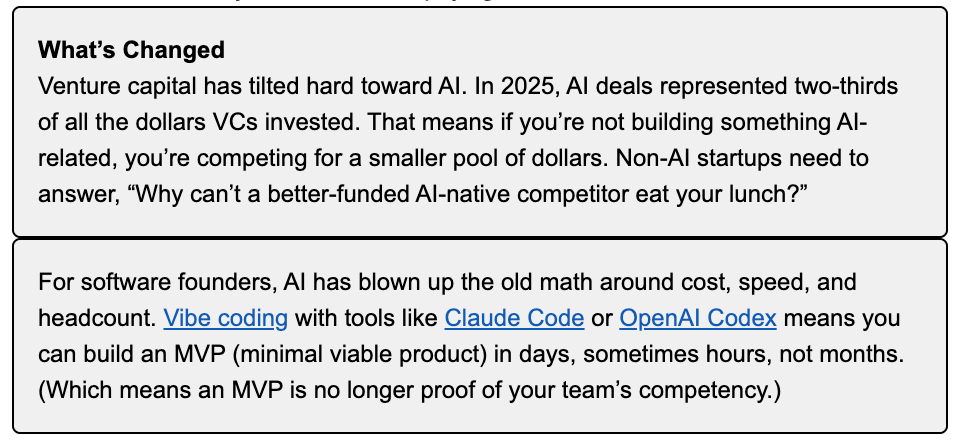
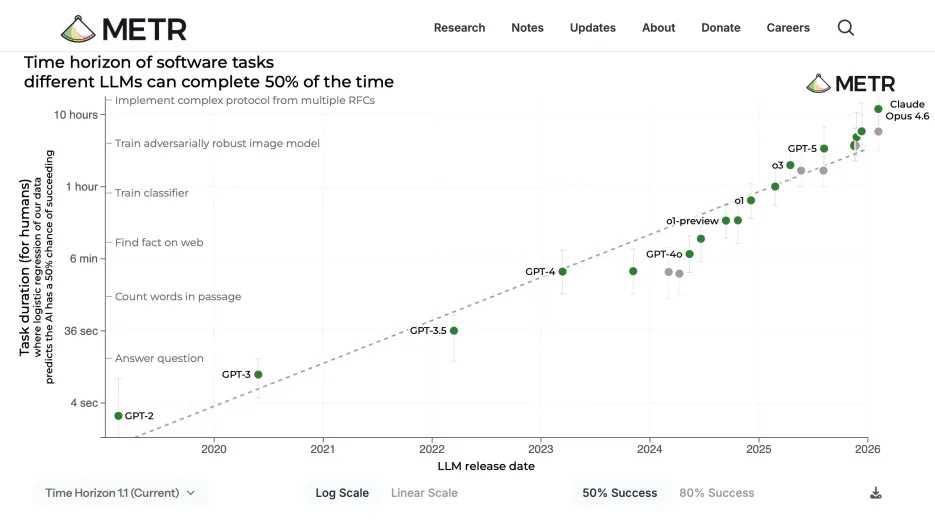
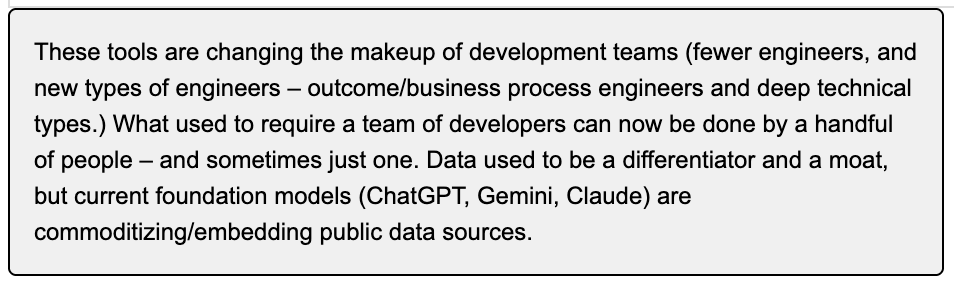
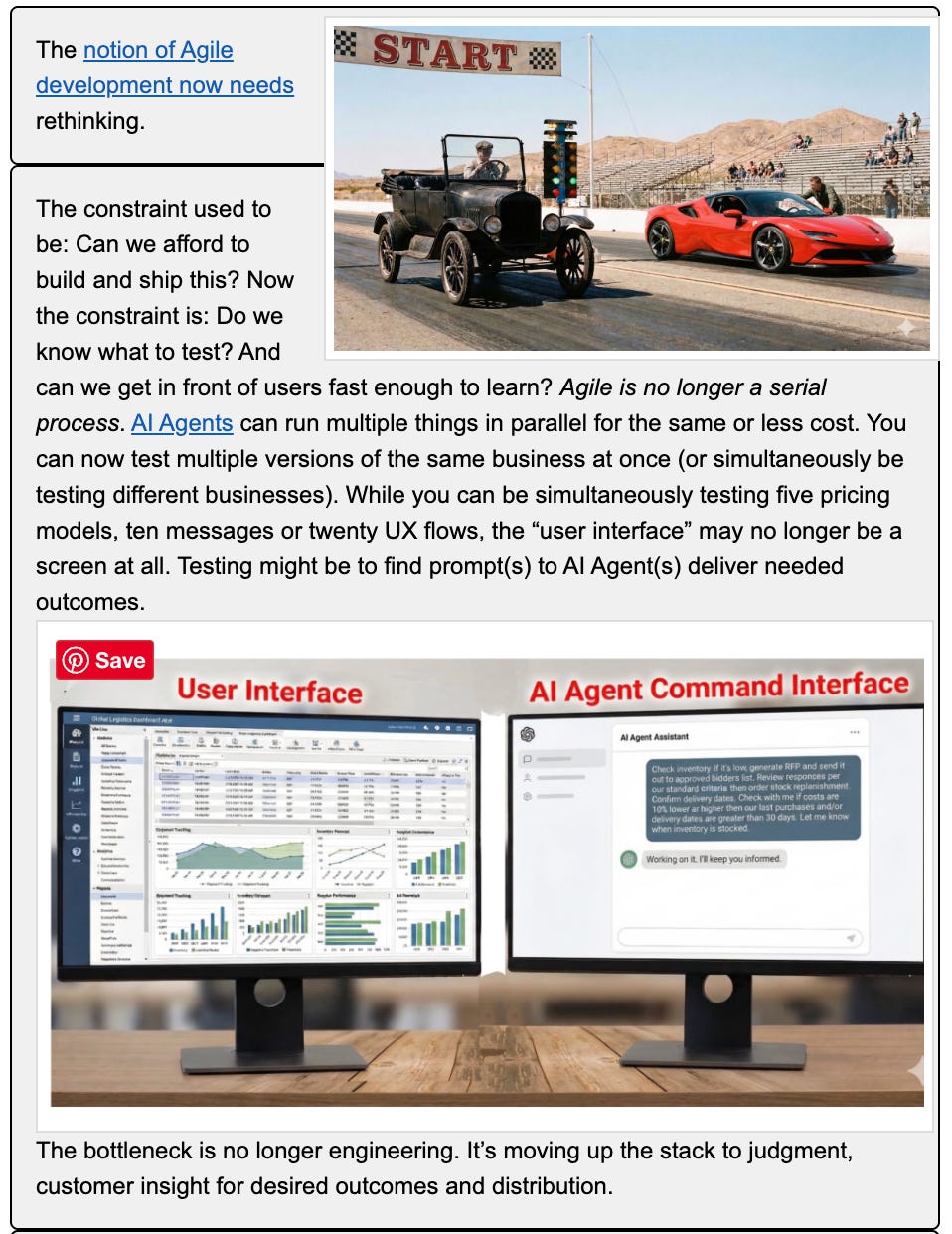
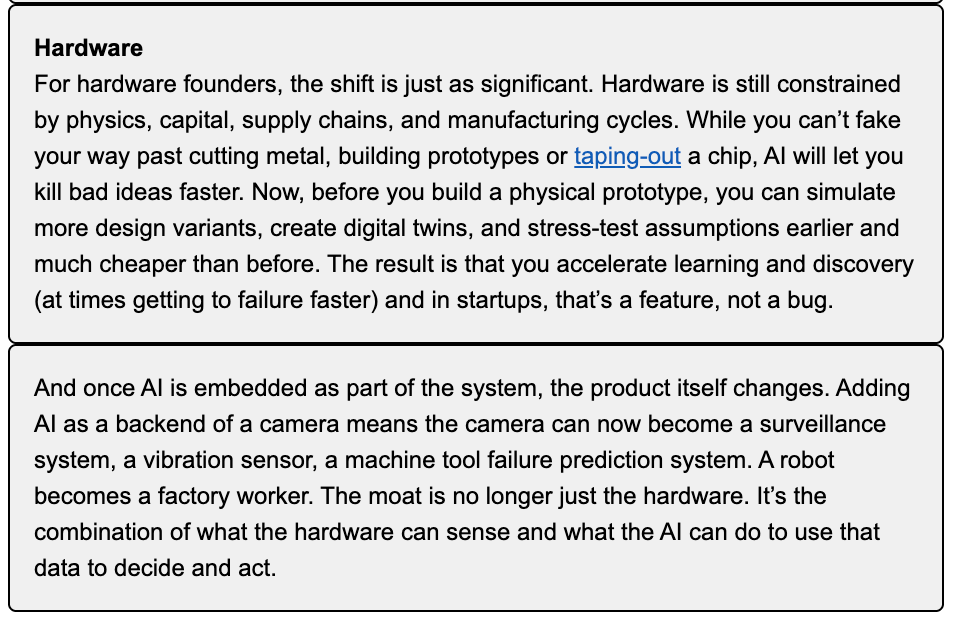
The Sunk Cost Trap
Founders who started pre-2025 typically have built a technical stack optimized for a world where software development was bespoke and expensive. While Agile development and DevSecOps made us lean, they operate in a serial fashion, and startups hired a team sized for this structure. Companies that have spent years developing a “moat” of proprietary code and features are waking up to the fact that AI is commoditizing most of their tech stack. This leaves startups trying to raise money for a business model that may be partially (or wholly) obsolete.
None of this may be obvious to a founding team when you’re heads down trying to ship a product and searching for product/market fit.
Technical stack, product features, user interface, number of employees, all of these sunk costs become reasons not to pivot: How can we throw away years of work? Our VCs funded this specific idea. Customers still want a UI. The team believes in this roadmap. Our customers aren’t ready for this. (Chris is a perfect example. He built something genuinely impressive, and likely still competitive, but the business model around it needs to change.)
Some sunk costs continue to be assets; deep domain knowledge, customer relationships, proprietary data, hard-won regulatory approvals, physical integrations – those are worth keeping. In Chris’s startup – that’s his airframe integration.
The sunk costs that are liabilities are a large engineering team built for slow software cycles, a pricing model based on seats, a product roadmap built around features rather than outcomes. These are what is known as the “Dead Moose on the table” – something so obviously wrong but that no one wanted to challenge.
The founders who survive will be the ones who can look at what they’ve built and ask: if I were starting this company today, using today’s tools in today’s market, what would I actually build?
That’s uncomfortable when you’ve raised money on a specific thesis. But it’s less uncomfortable than your investors telling you they’re not going to fund your next round, and going out of business defending an obsolete plan.
Lessons Learned
You don’t get to run a 2024 (or earlier) playbook in 2026
Everything has changed – fund raising, tech, business models
Agile development is changing to parallel development
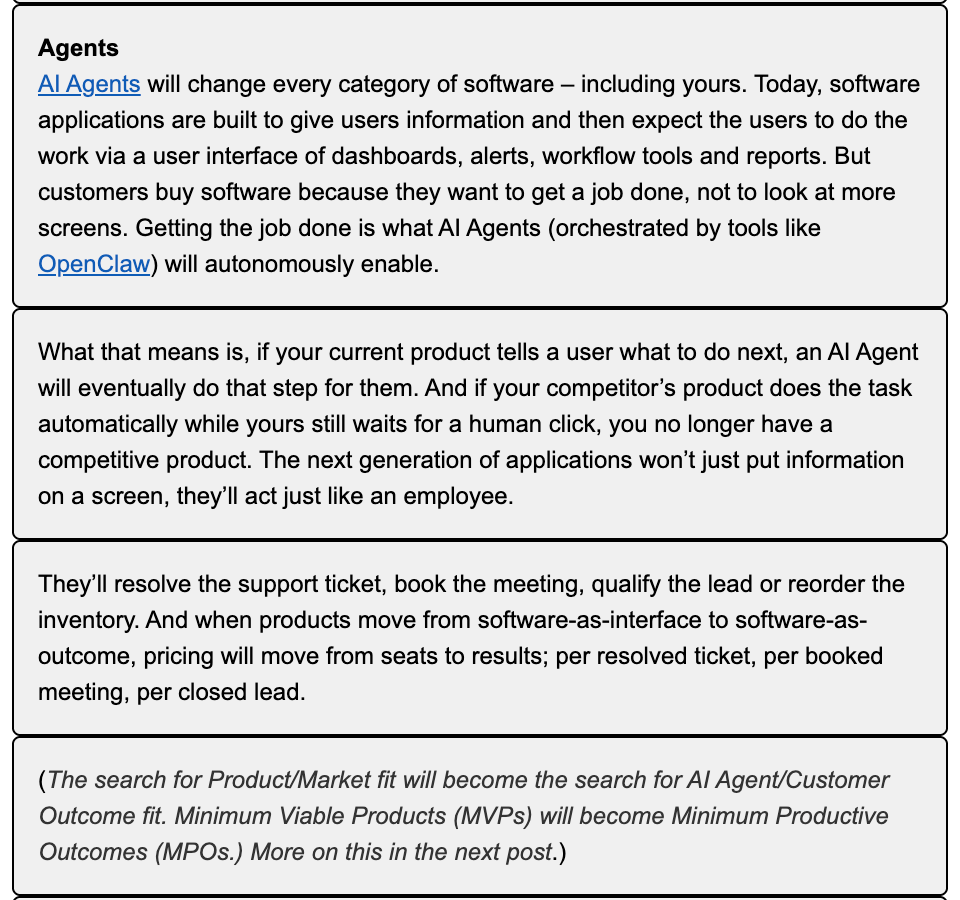
The search for Product/Market fit will become the search for AI Agent/Customer Outcome fit.
Minimal Viable Products (MVPs) will become Minimal Productive Outcomes (MPOs.) More on this in the next post
The sunk cost mindset will put you out of business
Defensible moats may still be found in having proprietary data, deep understanding of customer outcomes, getting regulatory lock-in, or being a Program of Record
If you’re not losing sleep, you haven’t understood what’s happening
Founders who survive will get out of the building to take stock, pivot and course correct
Fascinating that you apply the sunk cost trap, usually aimed at established companies, to startups.
I would push the question one step earlier. It is not just "what" would you build today with today’s tools and today’s market. It is "why" you would start at all, and whether you still have the right to play in this arena (in this case after six years).
Because once the world changes, the harder question is not whether the old stack, roadmap, or thesis still holds. It is whether this is still a game worth re-entering, given your capabilities, position, timing, and the new competitive logic.
Sometimes the real pivot is not a new solution direction. It is admitting that the original reason to be in the arena no longer holds.
What do you think?
Professor Blank..."The search for Product/Market fit will become the search for AI Agent/Customer Outcome fit." I think these insights are as groundbreaking as when your Lean start-up/business model canvas came out. More importantly, founders are desparately needed to break the oligopoly cartel of big tech. The big tech platforms (and their investors) are engineering a future where they reap 100% of the rewards, while society and workers are saddled with 100% of the costs (and other 'externalities'....to the detriment of our system of democracy, way of life, & natural environment). Like many others, I've become anxious and exhausted with the impending AI job-pocolypse. Maybe Agentic AI can be harnessed as a tool for the underdogs to level the playing field.