
Lean LaunchPad 2026 @ Stanford -- Lessons Learned Presentations

We just finished the 16th annual Lean LaunchPad class at Stanford.
In those 16 years, the class has gone from a radical idea – that the Lean method could provide a more productive framework for new startups – to something that everyone agrees is a way to build new startups.
The class had gotten so popular that in 2021 we started teaching it in both the winter and spring sessions.
During the 2026 spring quarter the eight teams spoke to 978 potential customers, beneficiaries and regulators. Most students spent 15-20 hours a week on the class, about double that of a normal class.
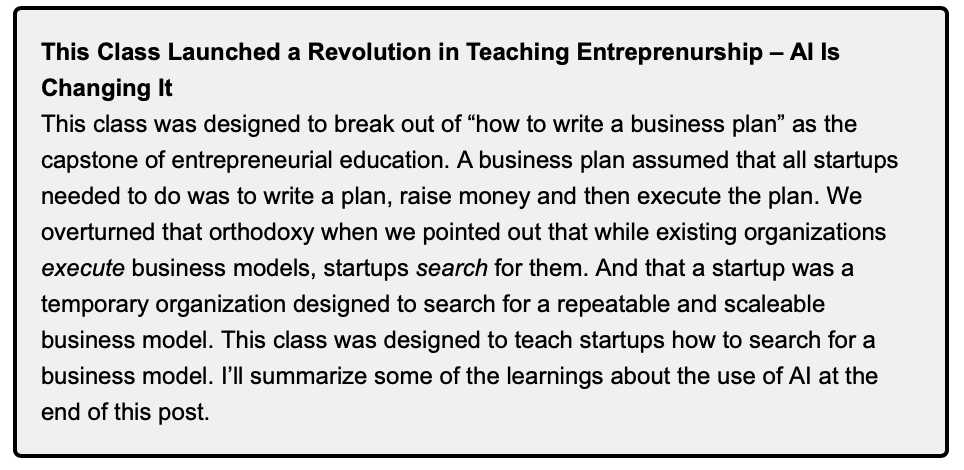
Several government-funded programs have adopted this class at scale. The first was in 2011 when we turned this syllabus into the curriculum for the National Science Foundation I-Corps. Errol Arkilic, the then head of commercialization at the National Science Foundation, adopted the class saying, “You’ve developed the scientific method for startups, using the Business Model Canvas as the laboratory notebook.” Now in its second decade and in 100+ universities, I-Corps has become a standard for science commercialization at the NSF, National Institutes of Health and the Department of Energy – training 3,251 teams and launching 1,400+ startups to date.
Team Office Hours
To see the Team Office Hours video, click here
To see the Team Office hours slides, click here
To see a demo of the Team Office Hours app, click here
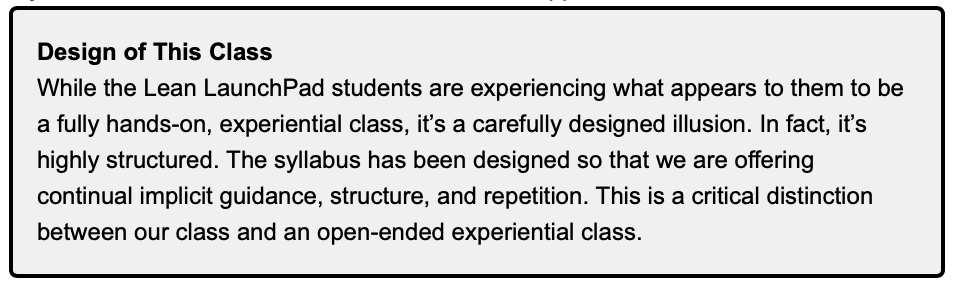
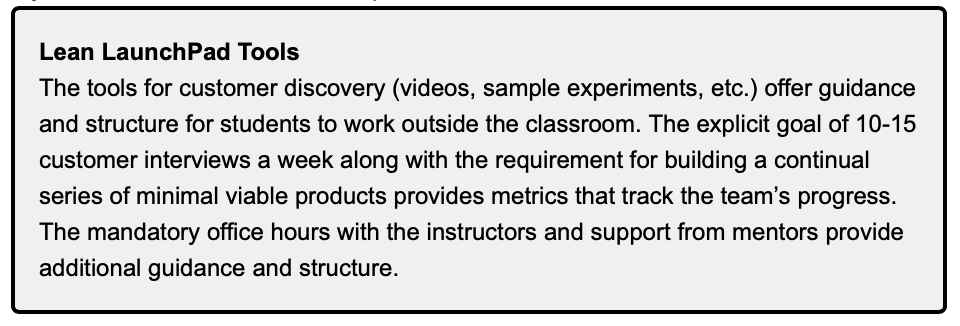
Guidance, Direction and Structure – For example, students start the class with their own initial guidance – they believe they have an idea for a product or service (Lean LaunchPad/I-Corps) or have been given a clear real-world problem (Hacking for Defense). Coming into the class, students believe their goal is to validate their commercialization or deployment hypotheses. (The teaching team knows that over the course of the class, students will discover that most of their initial hypotheses are incorrect.)
Team Izhaar
To see the Team Izhaar video, click here
To see the Team Izhaar presentation, click here
Team Trained on Me
To see the Team Trained on Me video, click here
To see the Team Trained on Me presentation, click here
Team Artemis
To see the Team Artemis video, click here
To see the Team Artemis presentation, click here
Team Remainder
To see the Team Remainder video, click here
To see the Team Remainder slides, click here
Team Microprint
To see the Team Microprint video, click here
To see the Team Microprint slides, click here
Team Vital Health
To see the team Vital Health video, click here
To see the team Vital Health presentation, click here
Team Nimbus
To see the Team Nimbus video, click here
To see the Team Nimbus presentation, click here
AI In the Classroom
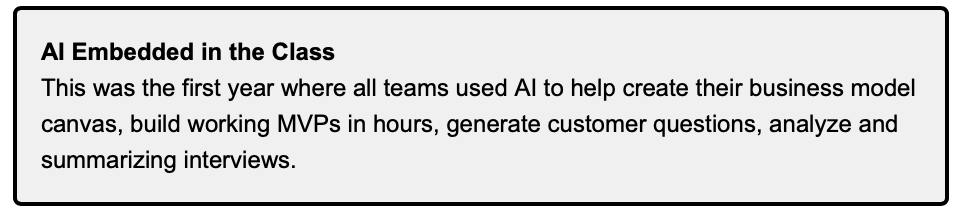
AI has had some obvious and not so obvious impacts on our class.
First, here’s a summary of how our students used AI in both classes I taught this quarter.
To see the AI Use In Class slide click here
AI Tools Used
Claude + Granola – were the AI tools used by everyone.
Large Language Models Used
– Claude, Claude Code, Claude Chrome extension, Claude Cowork, Claude Design
– ChatGPT
– Gemini
Note taking
– Granola
– Twinmind
Presentations
– Perplexity
Building prototypes
– Replit
– Lovable
Creating Synthetic Users
– Listen Labs
– Viewpoints AI
Summarizing Research
– Google NotebookLM
– Notion + G Suite (not strictly AI, but used as part of AI workflows)
Other
– Ultralytics YOLOv8 (used by the SwarmShield H4D team for drone detection/tracking MVP)
AI Classroom Usage
Three of our students did a tutorial of how they used AI in the classroom.
To see the AI Classroom Usage tutorial, click here
Impact of AI in the Classroom
The obvious and positive changes of AI were that teams were able to do customer discovery more efficiently. The not so obvious change was that creating products rapidly allowed teams to make bad ideas go faster. In the past, MVPs were a sign of a teams technical competence, but now spinning up something in hours that previously took weeks, means that an MVP is no longer evidence of critical thinking and hypothesis testing.
This meant student learning was unbalanced. A finished-looking product felt like success. Students confused a polished deliverable with the need to deeply understand the needs of all the stakeholders, as well as the need for Customer Validation. Team understanding was less nuanced. There was less depth uniformly across the teams about the problem they were solving and understanding customer needs. In this class it wasn’t the AI that was hallucinating – it was teams. They pivoted late as they assumed that a polished product meant product/market fit.
Going forward we’ll have students come into class with a prototype but next time accompanied by the explicit hypotheses and experiments they’ll use to validate whether the prototype solved an actual problem.
On the other hand, students built some amazing Claude Skills and Gemini Gems. They were tons of untapped opportunities to build digital twins or test 10’s or 100’s of apps simultaneously.
More about this in a separate blog post.
It Takes A Village
While I authored this blog post, this class is a team project. The secret sauce of the success of Lean LaunchPad at Stanford is the extraordinary group of dedicated volunteers supporting our students in so many critical ways.
The teaching team consisted of myself and:
Steve Weinstein, partner at America’s Frontier Fund, 30-year veteran of Silicon Valley technology companies and Hollywood media companies. Steve was CEO of MovieLabs, the joint R&D lab of the major motion picture studios.
Lee Redden – CTO and co-founder of Blue River Technology (acquired by John Deere) who was a student in the first Lean LaunchPad class 14 years ago! I wrote a post about Lee’s journey here.
Jennifer Carolan, Co-Founder, Partner at Reach Capital the leading education VC and author of the Hacking for Education class.
Our teaching assistants this year were: Roya Meykadeh, Aditi Mahajan, Alina Hu.
The teams were assisted by mentors: David Kopp, Mitch Singer, Pradeep Jotwani, Dave Epstein, Anil Kamath, Bobby Mukherjee, Rekha Pai, Venkat Krisnamurthy and mentor team coordinator Todd Basche.
Why not offer this lean mean startup how-to to the ordinary American?
Why not offer this lean mean startup how to to the ordinary American?